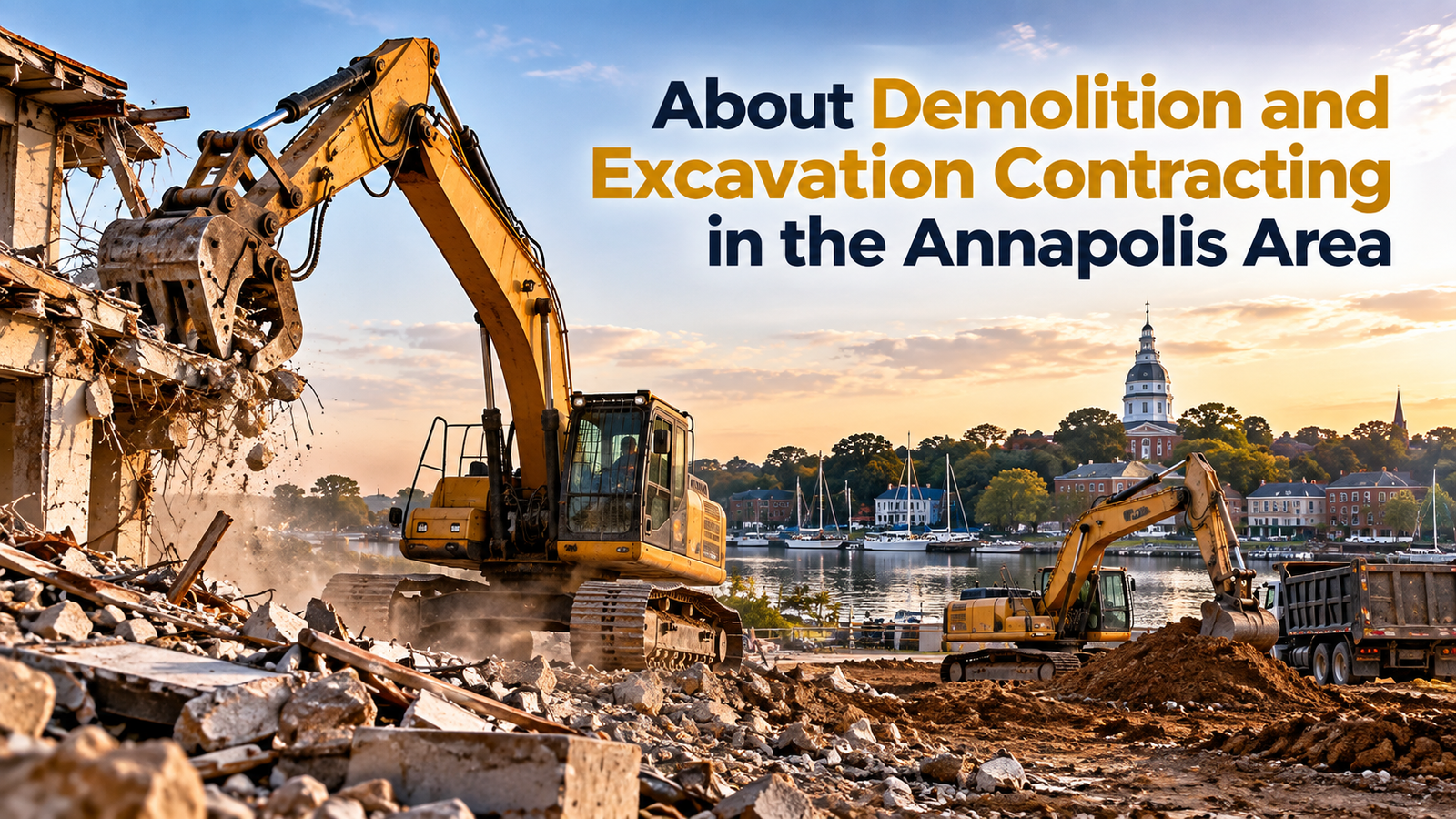
Annapolis is a city that demands a different kind of contractor. The combination of Chesapeake Bay waterfront geography, centuries of built history, Maryland’s environmental protection framework, and a dense urban core with tight lot lines creates a working environment unlike any other in Maryland. The contractors who work in this city well are the ones who come prepared with the right equipment, the right licenses, the right knowledge of local regulations, and a clear understanding of how to protect adjacent properties, natural resources, and the built fabric of one of America’s oldest continuously occupied cities.
This overview covers what it means to operate as a professional About Digger Demolition Annapolis and excavation contractor in Annapolis the licensing, the environmental responsibilities, the equipment considerations, and the way that preparation before the first machine is moved determines the quality of every project that follows.
What Licensed Demolition Contracting Looks Like in Maryland
In Maryland, contractors performing demolition and excavation on residential properties must hold a Maryland Home Improvement Contractor (MHIC) license issued by the Maryland Department of Labor’s Division of Occupational and Professional Licensing. Commercial demolition involves separate licensing and bonding requirements established at the state level and, for work within the City of Annapolis, additional registration requirements with the city’s Department of Planning and Zoning.
Licensing is not the only credential that matters. Competent demolition contractors in Maryland carry general liability insurance in amounts commensurate with the scale of their projects, workers’ compensation coverage for all employees, and in many cases contractor’s pollution liability coverage for projects involving asbestos, lead paint, or petroleum-contaminated soil. Surety bonding protects property owners in the event a contractor fails to complete work or abandons a project.
Beyond state licensing, professional demolition contractors working in Annapolis should have personnel who hold current certifications in asbestos supervisor or inspector roles from an accredited training provider, OSHA 10 or OSHA 30 construction safety cards, and first aid and CPR certification. These credentials reflect a sustained investment in safety training that is not optional on sites where pre-1978 structures are being removed.
Equipment and What It Means for Annapolis Projects
The equipment a demolition contractor brings to an Annapolis project reflects the constraints of working in a dense historic city. Full-size hydraulic excavators are standard for open-site commercial demolitions. In the historic downtown, narrow alleyways, limited staging areas, and proximity to neighboring structures mean that compact equipment mini-excavators in the three-to-eight-ton class is often the only machinery that can fit in the available space without damaging surrounding properties.
High-reach demolition equipment excavators with specialized boom configurations capable of reaching upper stories from grade level is used on taller commercial structures. This approach avoids floor-by-floor access and reduces the risk of floor system collapse during staged removal.
Dust suppression equipment water cannons, misting systems, and spray bars on excavator buckets is standard practice in Annapolis, where demolition work near occupied historic structures requires control of airborne particulate. This is a health and safety requirement under OSHA and a regulatory expectation under MDE’s air quality program for major demolition projects.
Environmental Responsibility in the Chesapeake Bay Watershed
Operating in Annapolis means operating in the watershed of one of the most studied and most regulated coastal water bodies in the world. The Chesapeake Bay receives runoff from more than 64,000 square miles of the mid-Atlantic watershed, and the quality of that runoff is shaped by every construction and demolition activity in the watershed.
Professional demolition and excavation contractors in Annapolis approach environmental responsibility as a core operational standard, not a compliance checkbox. Sediment and erosion control measures are installed before work begins and inspected daily. Dewatering discharge is managed and permitted. Concrete washout areas are contained and collected. Fueling and fluid changes for equipment are conducted on impermeable surfaces with spill containment. These practices reflect the expectation of working in a watershed that is the focus of a multi-state restoration program with federal oversight.
Maryland’s Department of the Environment enforces environmental standards on construction and demolition sites through announced and unannounced inspections. Violations can result in stop-work orders, civil penalties, and in serious cases criminal prosecution. Contractors who take these standards seriously protect themselves from liability while also contributing to the long-term health of the Bay watershed.
Community Context and Working in Historic Annapolis
Annapolis is a small city by population approximately 40,000 residents but it functions as a cultural and governmental center for a much larger region. It hosts the Maryland State House, the United States Naval Academy, and a visitor economy built on its extraordinary concentration of colonial-era architecture. Demolition and excavation contractors working in this environment understand that their work is visible, that neighbors are paying attention, and that the impacts of poor work noise, dust, vibration, damage to adjacent structures extend beyond the project site.
Noise ordinances in Annapolis restrict construction activity to defined hours on weekdays and Saturdays. Vibration limits apply near historic structures. Dust control is enforced both as an air quality requirement and as a nuisance ordinance matter. Contractors who plan their work to minimize impacts on the surrounding neighborhood staging efficiently, communicating with neighbors in advance, adhering to noise and hour restrictions build reputations that matter in a small city where word of mouth carries significant weight.
Pre-Project Planning: The Foundation of Every Successful Annapolis Project
The most important work on any Annapolis demolition or excavation project happens before equipment is delivered to the site. Pre-project planning includes reviewing the structural drawings for the building to be removed, confirming permit status and any special conditions imposed by the HPC or MDE, scheduling and coordinating utility disconnections with BGE and other providers, completing the asbestos and lead surveys, and briefing the project team on site-specific hazards and regulatory requirements.
Projects that skip or compress this planning phase are the ones that encounter stop-work orders, environmental violations, damage to neighboring properties, and delays that cost more than the planning would have. The Annapolis regulatory environment is not forgiving of shortcuts, and the consequences of unprepared work are not just financial they can affect a contractor’s license status and their ability to work in the city in the future.
Frequently Asked Questions About Demolition and Excavation Contracting in Annapolis
What licenses are required for a demolition contractor in Annapolis?
Maryland Home Improvement Contractor license for residential work, state contractor’s license for commercial work, and registration with the City of Annapolis Building Department. Asbestos work requires separate licensing through the Maryland Department of the Environment.
What insurance should a demolition contractor carry?
General liability, workers’ compensation, and contractor’s pollution liability are the standard coverages. Commercial demolition projects frequently require higher liability limits than the state minimum.
How does working near the Chesapeake Bay affect daily operations?
Critical Area regulations, stormwater and sediment control requirements, and MDE oversight of dewatering discharge all create operational obligations that are not present in inland projects. Environmental compliance is a daily management responsibility on Annapolis sites.
Why does pre-project planning matter more in Annapolis than in other jurisdictions?
The convergence of historic preservation review, Critical Area compliance, NESHAP asbestos requirements, and archaeological permit conditions creates a permitting and pre-construction process that cannot be compressed without risk. Planning done thoroughly before mobilization prevents the costly interventions that arise from mid-project surprises.
What role does community communication play in Annapolis demolition projects?
Neighbors in the historic core are often in close proximity to project sites and are aware of construction activity. Advance notification, adherence to noise and hour ordinances, and dust control measures are both regulatory requirements and practical necessities for maintaining the community relationships that support sustained work in the city.
Demolition and excavation contracting in Annapolis is, at its core, a discipline that requires combining technical skill with local knowledge. The regulatory frameworks, the soil conditions, the environmental obligations, and the historic context all demand a contractor who has invested in understanding the specific character of this city and who brings that understanding to every project, regardless of scale.